Why I Only Buy From Support and Sell From Resistance

Yusef Scott
Written by Yusef Scott, Founder of SDEFX University™ and Creator of the Trading Framework™
Why I Only Buy From Support and Sell From Resistance: The Foundation That Changed My Trading
A personal perspective from Yusef Scott on market levels, disciplined entries, probability, overtrading, and why support and resistance became the foundation of the Trading Framework™.
There is one principle that sits at the center of the way I approach the financial markets:
I only look to enter a BUY from support, and I only look to enter a SELL from resistance.
This is not a rule I adopted because it sounded good.
It is not something I repeat simply because other traders have said it.
This principle became part of my trading philosophy after years of studying the market, making mistakes, questioning my entries, and finally recognizing that where I entered was just as important as the direction I expected the market to move.
Support and resistance were not the first concepts I learned.
They were among the last.
During my earlier years in the financial markets, I shied away from learning levels because I was intimidated by them.
I thought identifying the correct support and resistance areas would be one of the most complicated parts of trading to master. Looking at a chart filled with highs, lows, reactions, reversals, and potential zones made the process appear overwhelming.
Because of that intimidation, I kept putting it off.
I studied other concepts first.
I watched candles.
I explored indicators.
I searched for strategies that appeared easier to understand.
I tried to make sense of the market without fully understanding the foundation beneath price movement.
Meanwhile, the concept I continued avoiding was the exact concept my trading needed most.
The same thing that intimidated me would eventually provide the structure I had been searching for.
The same lesson I left until last would become the lesson I now teach first.
The same thing I was shying away from would literally change my life.
The Lesson I Feared Became My Greatest Source of Structure
Before I understood support and resistance, it was easy to look at the market as a collection of moving candles.
A green candle made the market appear bullish.
A red candle made the market appear bearish.
A strong move upward could make buying seem like the obvious decision, while a sharp move downward could make selling feel equally obvious.
However, a candle cannot be properly evaluated without understanding its location.
A green candle moving directly into resistance does not necessarily represent a good buying opportunity.
A red candle moving directly into support does not necessarily represent a good selling opportunity.
The candle provides information.
The location gives that information context.
When I finally committed to learning support and resistance, I stopped asking only whether price was moving upward or downward.
I began asking better questions.
Where is price now?
Where did the move begin?
What level is price approaching?
Where did buyers previously enter with strength?
Where did sellers previously take control?
Is the market moving toward an area where the current momentum may slow down?
Am I entering near the beginning of an opportunity, or am I chasing after much of the move has already occurred?
Those questions changed the way I viewed the financial markets.
I stopped seeing random candles and started seeing locations.
I stopped responding to every movement and began waiting for price to reach an area that made sense.
I stopped allowing emotion and momentum to make my decisions.
That is when my foundation started to strengthen.
Fidelity describes support as an area where buying interest may become strong enough to interrupt a decline, while resistance is an area where selling pressure may restrict or reverse an advance. These levels can help traders organize possible entries, exits, and risk decisions, but they are probability-based tools rather than guarantees. Read Fidelity’s explanation of support and resistance.
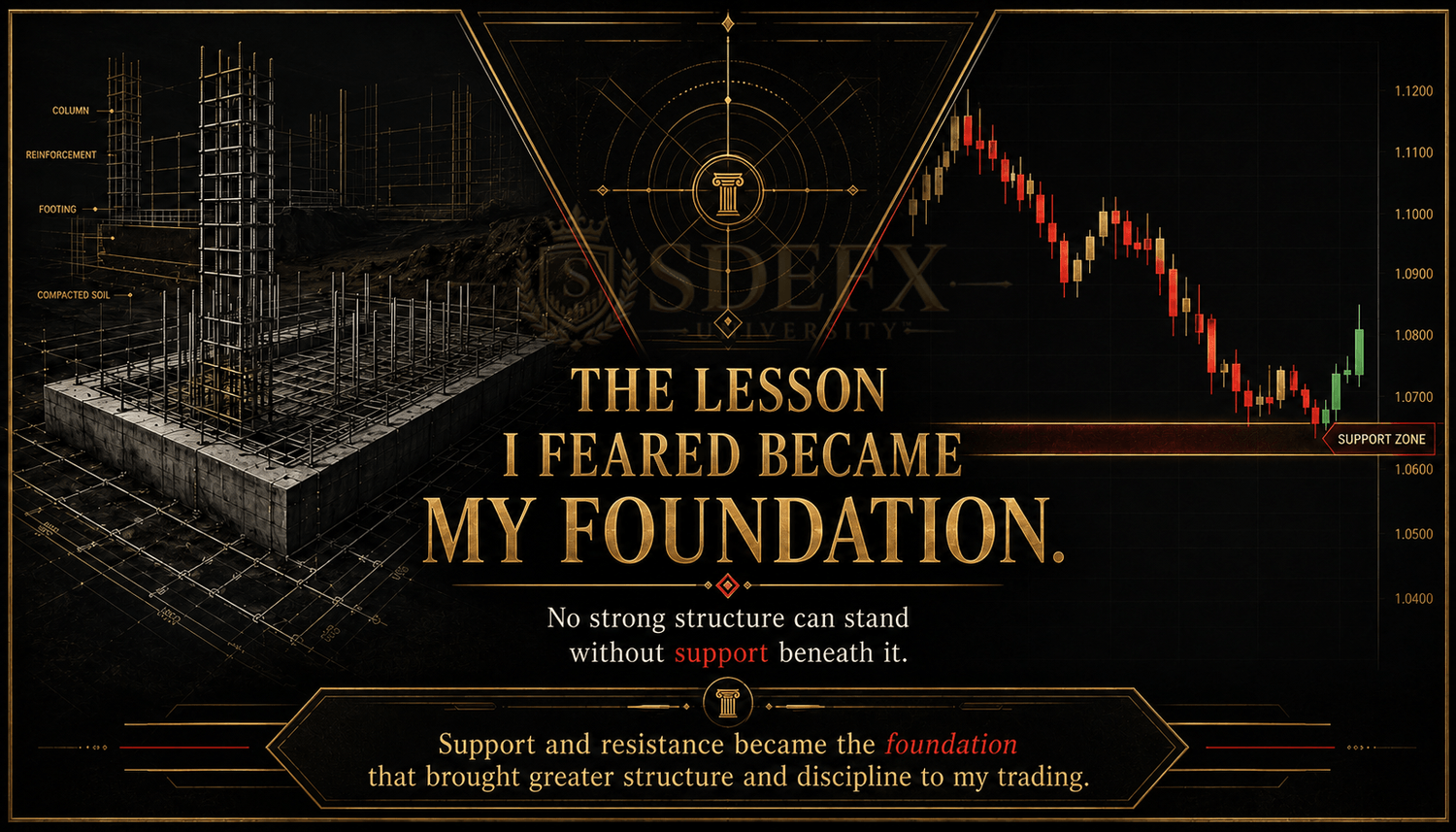
Real Estate Helped Me Understand Why a Foundation Matters
I entered the real-estate market around the same period that I entered the financial markets.
Because of that experience, I already understood one universal principle:
You cannot build a dependable structure on a weak foundation.
A building can have beautiful finishes, expensive materials, impressive architecture, and a polished exterior. However, if the foundation underneath that building is unstable, everything constructed above it remains vulnerable.
The same principle applies to trading.
A trader can collect indicators, strategies, signal services, chart patterns, entry techniques, and market opinions. However, if those tools are not supported by an understanding of market structure and location, the trader may still struggle to determine where a trade logically belongs.
Support and resistance became that foundation for me.
Levels gave me reference points.
They helped me understand where price had previously reacted, where buying activity could potentially increase, where selling pressure might appear, and where the original reason for entering a trade could become invalid.
They also helped me understand that not every part of the chart deserves my participation.
Once I understood that principle, trading began to feel less like guessing and more like studying a structure.
That is why All About Levels™ became the first component of my Trading Framework™.
Levels do not guarantee what the market will do next.
They give me an organized location from which to evaluate what the market may do next.
That is a major difference.
This lesson also connects to one of my earliest trading experiences, when I grew an account from approximately $530 to nearly $2,000 in a short period and then lost the account. At that time, I was reacting to candle movement without a complete understanding of levels, market structure, exposure, or defense. You can read that story in From $530 to $2,000—and Then a Blown Account.
What Support and Resistance Actually Represent
Support and resistance should not be treated as magical lines that force the market to turn.
They represent areas where the relationship between buyers and sellers has previously changed.
Support is an area where buying activity has historically become strong enough to slow, stop, or reverse downward movement.
Resistance is an area where selling activity has historically become strong enough to slow, stop, or reverse upward movement.
I often think of support as a potential floor beneath price and resistance as a potential ceiling above price.
However, these floors and ceilings are not made of concrete.
They can break.
They can weaken after repeated tests.
They can be temporarily breached.
They can also reverse roles.
A previous resistance level may become support after price moves above it and confirms the breakout. A previous support level may become resistance after price moves below it.
That is why I look at support and resistance as areas for evaluation rather than automatic entry commands.
Charles Schwab similarly describes support and resistance as potential price floors and ceilings where buying or selling pressure may become more influential. Schwab also explains that these areas can add clarity to a trader’s decision-making process. Read Schwab’s support-and-resistance overview.
There Are Only Two Directions, but Trading Is Not Automatically a Coin Toss
At the most basic directional level, the market can move in one of two directions:
Up or down.
A trader can also enter one of two directional positions:
Buy or sell.
At first glance, that can make trading appear to begin with a 50% chance of choosing the correct direction.
However, an actual trading outcome is not the same as flipping a coin.
Direction is only one part of the decision.
A trader may correctly determine that the market will eventually move upward and still lose because the buy entry was taken directly beneath resistance.
A trader may correctly determine that the market will eventually move downward and still lose because the sell entry was taken directly above support.
A trade can also be affected by timing, spread, slippage, leverage, position size, volatility, news, market-session behavior, emotional decision-making, and how the position is managed after entry.
Therefore, the existence of two directions does not automatically create a true 50% win rate.
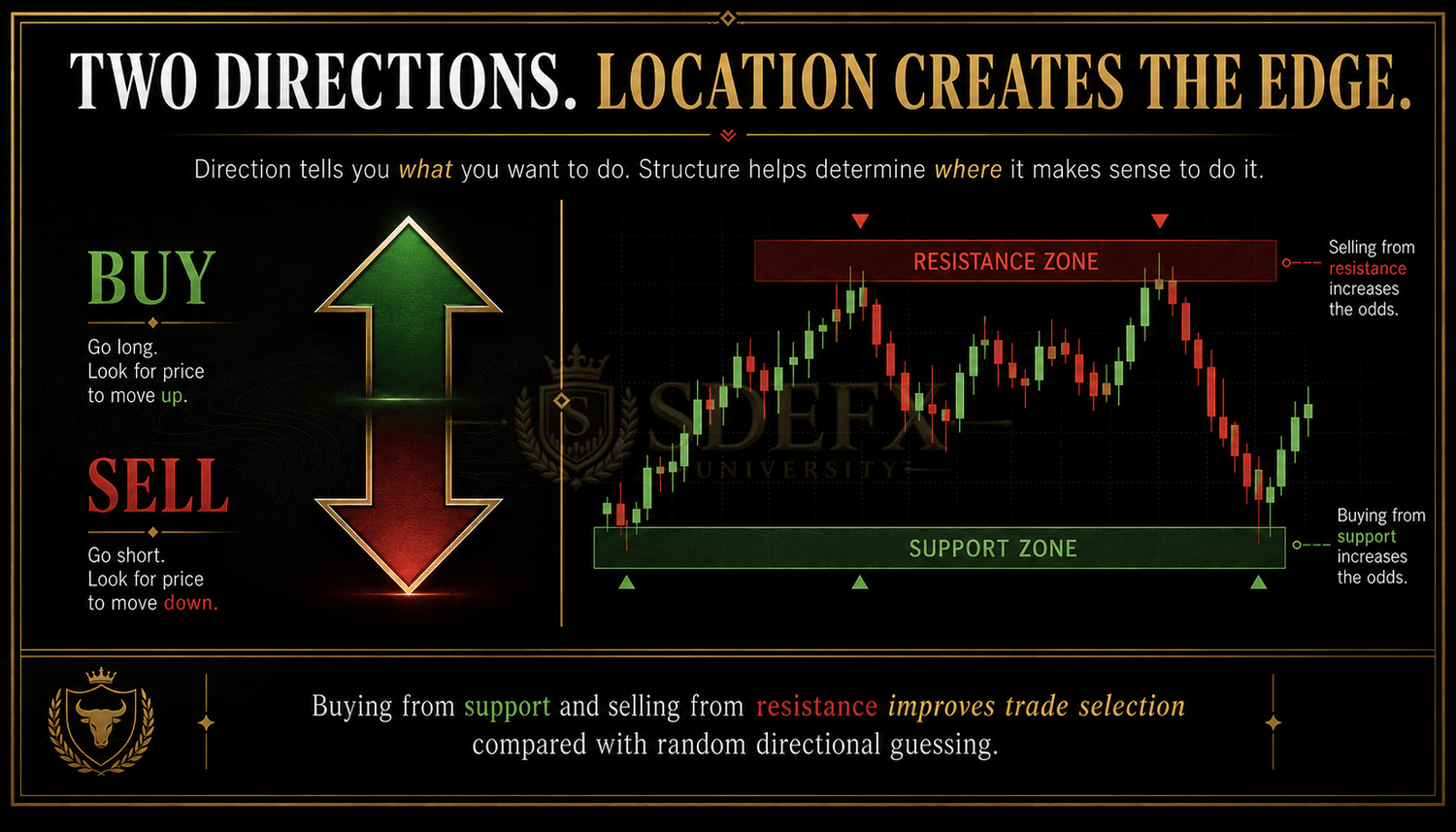
What support and resistance can do is help remove some of the weakest and most random decisions from the process.
Instead of asking only, “Should I buy or sell?” I ask a more useful question:
Has price reached a location where I am willing to participate?
That question changes the entire nature of the trade.
It moves the decision away from guessing at direction and toward evaluating location, structure, confirmation, and risk.
My Personal 75% Probability Standard
When I say that buying from support and selling from resistance may increase the probability of winning to 75% or more, I am not claiming that every support or resistance trade carries a guaranteed 75% win rate.
I am describing the level of confidence I may personally assign to a fully qualified setup after the relevant parts of my Trading Framework™ have aligned.
The level alone does not create that probability.
The support or resistance location must make sense.
The price reaction must make sense.
The entry conditions must make sense.
The available room for price to move must make sense.
The exposure must make sense.
The trade must also satisfy my defensive, psychological, and money-management requirements.
When all of those elements align, I may view the setup as highly probable.
However, that is a personal assessment based on my experience and framework. It is not an audited performance statistic, a universal win rate, or a guarantee of future results.
The more responsible way to state the principle is this:
Buying from qualified support and selling from qualified resistance can substantially improve the quality of an entry compared with randomly choosing a direction or chasing price after it has already moved.
My goal is not to convince traders that a level cannot fail.
My goal is to teach them how to stop entering from locations that are already working against them.
Why I Refuse to Buy From Resistance
One of the most common mistakes I see new traders make is buying after the market has already completed a large upward move.
They see a powerful bullish candle.
The market appears strong.
They feel as though the opportunity is leaving without them.
Fear of missing out begins to take control.
They enter the buy because the candle is moving upward.
However, they fail to ask the most important question:
Where am I buying?
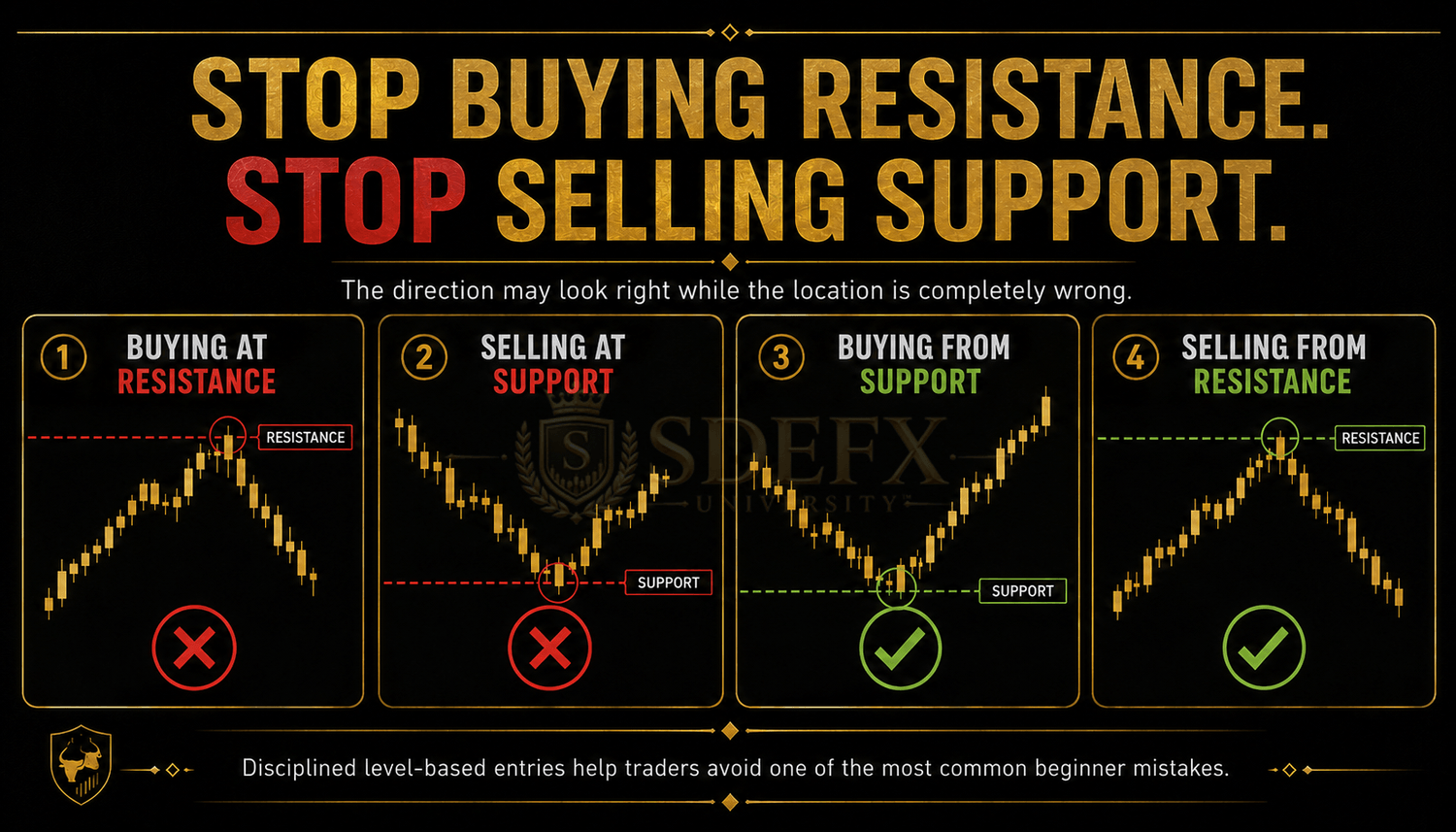
In many cases, they are buying directly into resistance.
They are entering near an area where sellers may begin applying pressure, where earlier buyers may take profits, and where the market may be preparing to pause, retrace, or reverse.
The trader may have correctly identified the recent direction of the market.
The location of the entry is still poor.
That is why I teach traders that they can be correct about direction and still lose because of location.
Buying from support allows me to evaluate an opportunity near an area where buyers have a logical reason to become active.
Buying at resistance often means I am chasing the market after much of the movement has already taken place.
It can also mean that my potential upside is becoming smaller while my exposure to a pullback is becoming greater.
That is not how I want to trade.
I do not want the size or color of a candle to make the decision for me.
I want the level, structure, confirmation, available room, and complete framework to justify the entry.
Why I Refuse to Sell From Support
The same mistake occurs in the opposite direction.
A new trader sees a large bearish candle and assumes price will continue falling.
The movement appears convincing.
Fear enters the decision.
The trader sells because price is moving downward.
However, that sell may be occurring directly into support.
The trader may be entering at the exact location where buyers could begin becoming more active.
Instead of participating near the beginning of the downward opportunity, the trader may be selling after much of the move has already occurred.
Price may be preparing to pause, retrace, or reverse.
That is why I teach:
Do not buy simply because the candle is green.
Do not sell simply because the candle is red.
A candle is information.
It is not an instruction.
The trader must understand where that candle exists within the complete market structure.
A bearish candle approaching support and a bearish candle breaking away from resistance may look similar in isolation.
Their locations make them two completely different situations.
The Major Mistake New Traders Often Make
New traders frequently do the opposite of what market structure suggests.
They buy after the market has already moved upward into resistance.
They sell after the market has already moved downward into support.
They buy near the top of an established range and sell near the bottom.
Then, when price reacts from the level, they believe the market suddenly changed direction against them.
In reality, the trader may have entered directly into the area where a reaction was already more likely to occur.
Buying from resistance and selling from support can create several problems.
The trader may have limited room for the position to develop.
The next opposing level may be too close.
The trader may be entering after momentum is already extended.
The market may begin retracing shortly after the entry.
The trader may then panic, exit, reverse direction, and become trapped in a cycle of chasing price.
This is how whipsawing begins.
The trader buys because price moved upward.
Price reaches resistance and reverses.
The trader closes the buy and enters a sell.
Price reaches support and reverses again.
The trader closes the sell and enters another buy.
The market may have remained inside the same range the entire time.
The trader was not losing because the market was impossible to understand.
The trader was repeatedly entering from the wrong side of the structure.
Trading From Levels Helps Me Avoid Overtrading
Support and resistance do more than help me identify where an opportunity may exist.
They also help me recognize when no trade is necessary.
When price is not at one of my qualified locations, I do not need to manufacture a setup.
I do not need to enter because I am bored.
I do not need to enter simply because the market is open.
I do not need to chase a candle because someone else posted a profitable trade.
I can wait.
That patience is one of the greatest benefits of building a trading process around levels.
A trader without defined locations can create a reason to enter almost anywhere.
A trader with defined locations understands that most market movement does not require participation.
This discipline can help reduce chasing, emotional entries, revenge trading, constant directional switching, entering in the middle of a range, and opening multiple positions without a valid structural reason.
The objective is not to take the greatest number of trades.
The objective is to take the opportunities that satisfy the requirements.
One highly qualified trade can be more valuable than ten emotional entries.
The CFTC warns that retail forex trading can involve substantial risk, that leverage can magnify losses, and that transaction costs and frequent trading can work against retail participants. Read the CFTC’s retail forex advisory.
The Level Is the Beginning, Not the Entire Strategy
I do not automatically buy every support level.
I do not automatically sell every resistance level.
A level identifies an area where I should begin paying closer attention.
It does not automatically command me to enter.
Before considering a buy from support, I want to understand whether the support area is meaningful, whether price has reacted from it before, and whether the level is visible on the timeframe that matters for the setup.
I also evaluate how price approached support.
A controlled move into a level may communicate something different from a violent news-driven move.
I want to see evidence that buyers are responding.
I also want to know where the next resistance area is located. There must be enough room for the position to develop before price reaches the next opposing area.
Most importantly, I must understand what would invalidate the buy idea.
The same process applies when I consider a sell from resistance.
I want to know whether the resistance area is meaningful, how price approached it, whether sellers are responding,
where the next support area is located, and what would invalidate the sell thesis.
The level identifies the location.
The complete Trading Framework™ determines whether I should act.
Support and Resistance Are Better Understood as Zones
One mistake traders often make is treating support and resistance as perfectly precise prices.
They draw a thin line and expect the market to reverse at that exact number.
However, market reactions frequently occur across an area rather than at one perfect price.
That is why I often think in terms of levels and zones.
A zone gives the market room to test, react, and reveal what buyers and sellers are doing.
This does not mean that every large area should be labeled support or resistance.
The zone still needs to be defined with discipline.
However, understanding that reactions may occur across a range can prevent traders from believing that a level failed merely because price moved slightly through one exact line.
It can also help them focus on the price response instead of rushing into an entry at the first touch.
When Support and Resistance Change Roles
Support and resistance do not remain fixed forever.
When price decisively breaks through resistance, that previous resistance area may later become support.
When price breaks through support, that previous support area may later become resistance.
This role reversal is one of the reasons traders must remain flexible.
I am not loyal to a line.
I am loyal to what the market is showing me.
If resistance breaks and price successfully retests the area from above, I must recognize that the market structure may have changed.
If support breaks and price retests that area from below, the previous buying zone may now attract selling pressure.
High Probability Does Not Mean No Risk
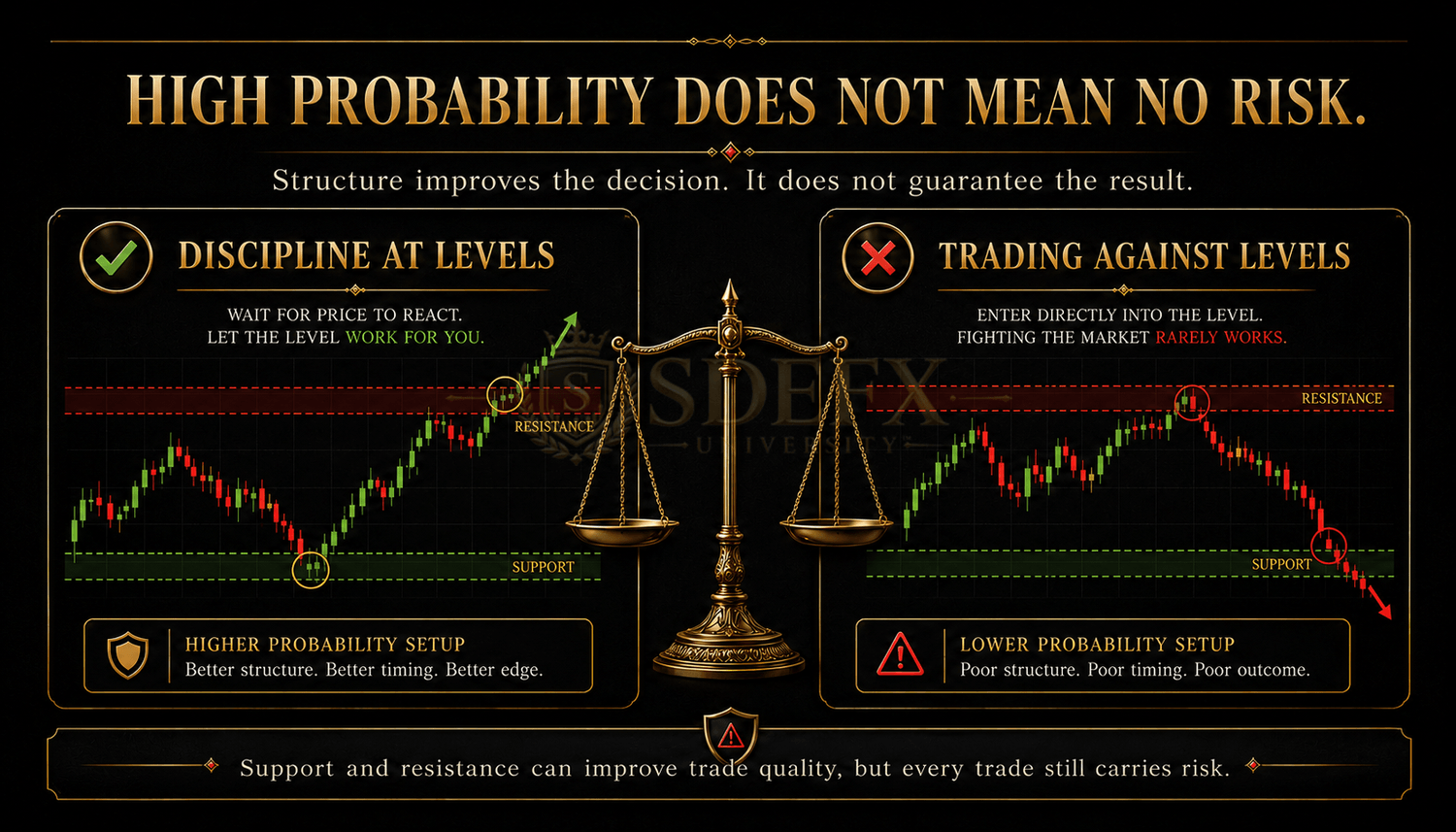
A qualified support level can break.
A qualified resistance level can fail.
A disciplined trade can lose.
An undisciplined trade can occasionally win.
That is why traders should not judge the quality of their complete process solely by the result of one position.
The better question is:
Did I follow a sound, repeatable, and defensible process?
Support and resistance help me define why I am considering a trade, where I may be willing to participate, where opposing pressure may appear, and what market behavior could invalidate the original idea.
They do not guarantee profit.
Technical analysis is based on probability, not certainty.
Market conditions can change.
Unexpected news can increase volatility.
Spread, slippage, leverage, execution, position size, and emotional discipline can all affect the result.
My confidence comes from preparation and structure.
It does not come from believing the market owes me a winning outcome.
Support and Resistance Became the First Layer of My Trading Framework™
Support and resistance are not isolated concepts within my approach.
They are the foundation upon which the other components are built.
My Trading Framework™ includes All About Levels™, Money Management, Mental and Psychology, the Perfect Entry Strategy, and the US30 Proprietary Strategy.
Each component serves a different purpose.
Levels help identify the location.
Money management helps control exposure.
Mental and psychological discipline help the trader remain patient and avoid emotional execution.
The Perfect Entry Strategy helps refine the conditions required before entering.
The US30 Proprietary Strategy helps apply the broader framework to the primary market I trade and teach.
The framework is designed to help traders understand that one candle, one indicator, or one entry technique cannot carry the entire responsibility of the decision.
The pieces must work together.
At SDEFX University™, students receive education, market levels and zones, Signals With Guidance™, and market breakdowns designed to explain why an opportunity is being considered. The objective is not simply to give traders something to copy. It is to help them understand the structure developing around the setup.
The Trading Lesson That Changed My Life
Support and resistance were the concepts I avoided the longest.
I thought levels would be too complicated.
I believed I might struggle to understand them.
I convinced myself that I could build my trading around something easier.
However, when I finally committed to learning support and resistance, I discovered that levels were not the obstacle.
They were the foundation.
I stopped seeing random candles.
I began seeing locations.
I stopped entering simply because price was moving.
I began waiting for price to reach the areas that mattered.
I stopped treating every market movement as a trading opportunity.
I began understanding that patience is part of the strategy.
The concept I feared learning became the concept that gave me structure.
The lesson I avoided became the lesson that strengthened my foundation.
The subject I left for last became the philosophy I now teach first:
Only buy from support. Only sell from resistance.
I do not follow that principle because I believe every support level will hold.
I do not follow it because I believe every resistance level will reject price.
I follow it because structure provides something guessing never can:
A reason for the entry.
A location for the risk.
A framework for the decision.
The Purpose of SDEFX University™
Today, I operate SDEFX University™, where the objective is not simply to show traders how to press buy or sell.
We develop traders.
Many students arrive after years of chasing candles, switching strategies, overtrading, entering without structure, and depending on signals they do not understand.
They do not always need another indicator.
They often need a complete framework.
Through the Trading Framework™, Signals With Guidance™, All About Levels™, market breakdowns, and structured education, students can begin learning how the pieces of the market work together.
The signal may reveal the opportunity.
The guidance should help the trader understand why the opportunity exists, what the market is doing, and how the setup fits within the broader structure.
The long-term objective is not permanent dependence.
The objective is development.
Traders who are ready to move away from random execution can explore the education and membership options available through SDEFX University™ and Signals With Guidance™.
If they are really tired of struggling to trade, it is time to get the edge most traders never get.
Final Thoughts
I understand why support and resistance intimidated me during my earlier years.
At first, the chart appeared filled with endless possible levels.
I thought learning them would make trading more complicated.
Instead, levels made the market clearer.
They helped me understand where I wanted to participate and where I was willing to wait.
They helped me stop buying after price had already reached resistance.
They helped me stop selling after price had already reached support.
They encouraged me to become more selective.
They helped reduce overtrading.
They forced me to respect location instead of reacting emotionally to candle movement.
The thing I avoided became the thing that strengthened my entire trading philosophy.
That is why my rule remains the same:
I only enter the market on a BUY from support and a SELL from resistance.
I am not attempting to trade every candle.
I am not attempting to participate in every move.
I am waiting for price to reach a location where the opportunity makes structural sense.
Because trading should not begin with excitement.
It should begin with a foundation.
Risk Disclosure
Trading forex, indices, contracts for difference, futures, and other leveraged financial products involves substantial risk and is not suitable for every individual.
This article presents Yusef Scott’s personal perspective and is provided solely for educational and informational purposes. It is not financial, investment, tax, or legal advice.
Support and resistance levels, technical analysis, market examples, Signals With Guidance™, trade setups, educational strategies, and probability assessments do not guarantee profitable outcomes.
Any reference to a potential 75% probability reflects Yusef Scott’s personal assessment of certain fully qualified setups within his Trading Framework™. It is not an audited or guaranteed win rate, and individual results will vary.
Past performance is not indicative of future results. Traders remain responsible for their own entries, exits, position sizing, exposure, broker selection, risk management, and financial decisions.
Never trade with money you cannot afford to lose.
Read the complete SDEFX University™ Risk Disclosure.
About The Author

Yusef Scott
Yusef Scott is the founder of SDEFX University™ and creator of the Trading Framework™, Signals With Guidance™, and the Defensive Trading Playbook™. With more than two decades of financial-market experience and over 15 years mentoring traders, he specializes in helping serious traders approach US30, Forex, and global markets with greater structure, discipline, risk awareness, and confidence.